这篇文章不教你怎么给 AI 写提示词。它讲的是怎么思考、怎么解决问题、怎么负责任地用 AI 把一个复杂的想法真正落地,同时不把真实和虚构搅在一起。
上周,我得给一整套视频广告做策划。要推广的是我们的高阶数学课:乡村学校、以及免费或减价午餐比例超过 85% 的学校,孩子们上课全免费;其他人的价格也很公道。我心里的画面是:假如苹果、Buc-ee’s 和迈克尔·杰克逊联手做一支广告,会是什么样?问题只有一个:我既没有设计师,也没有预算。
9 月 11 日补记为免误会,说明一下:我们其实正在招聘一位全职的、认同我们使命、能和团队一起长期成长的设计师,预算也是有的。但这套广告当时必须马上上线,这才逼着我去琢磨:一个人靠 AI,到底能把事情做到什么程度。所谓"没有预算","没有"并不是零,而是相对于大公司的设计团队而言。经过这次经历,我更想找到一位设计师,一起去探索创意的边界。粗活交给我们新的 AI 系统,让设计师自己的迭代和创新以数倍的速度推进。
好在我手上有一支自己很喜欢的范例,是一年多前 Julia Du 专门为我们设计的。她很有才华,从帕森斯设计学院毕业、去谷歌上班之前,在我们这里做过一段兼职。
靠着 Claude、Codex、Remotion、Storyblocks、Google Lyria 和 ElevenLabs,我们现在总算有了一整套广告。当然,跟专业设计师的作品还没法比。但在课外数学培训这个行业里,它好像已经把其他家的广告都比下去了。要知道,那些公司的营销预算大得很,而我们是把利润拿去给低收入地区和乡村的孩子上课的。
我是做教育的,所以想把这套"做法"分享出来。先说清楚:这件事和剪视频不是一回事(很多人说,剪辑现在可以直接让 GPT-6 Astra 用你平常的剪辑软件"顺手做掉")。这更像是贝多芬在谱一部交响曲,而不是顶级混音师在调几条音轨。
「做一支视频广告」
我早就知道,要是直接跟 AI 说"做一支视频广告",多半会得到一个又平庸又无聊的东西。(这背后有个数学道理,下面会讲。)当时我懒得试,但为了好玩,我刚刚试了一下,提示词是这样的:
它做出了这个:
唉。看着就平庸(后面细说)。Julia 那支视频的精华,在于让文字在每一帧里俏皮地出现,这一点全没了。ChatGPT 也弄不到真人的视频,人情味也就没了。好歹它没有用 AI 生成假人。版面和细节看着都很糙。倒是文案本身,也许还说得过去。
如果你好奇,几天之后,我在已经用 Claude 做成之后,又拿 OpenAI Codex(GPT-5.6 Sol High Effort)试了一次。哪怕给了提示,还能看到 Claude 的全部代码和我们后来生成的配乐,它交出来的也就是这两版。多去探索、看看有没有更好的路子,总是值得的;不过实验完,我还是换回了 Claude Fable 5.1。
256 的 60 亿次方
AI 生成视频这么难,有一个数学上的原因:视频空间的维度大得吓人。最粗略地算,一支 30 秒、1000×1000、每秒 60 帧的视频,一共是
个像素,每个像素又各有红、绿、蓝三个数值,总共 60 亿个维度。所谓做出一支出色的视频,其实就是把这 60 亿个数值都选对。(你要是觉得中 Powerball 头奖已经够难了,那"不过是"猜对 6 个数字而已。)如果每个数值都在 0 到 255 之间,那就有
种可能要从中挑选。
相比之下,写一条 150 个字符的英文推文,"只有"大约 种可能。要命的是指数,而 150 比 60 亿小太多了,所以照理说,文字应该比视频好生成得多。说到底,AI 算法(也许还有我们人类的智能)要做的,就是把值得考虑的维度大幅压下去。
这大概就是 AI 生成的视频常常显得"平庸"的原因:要在所有可能性里搜索、优化,时间长到根本不可能。可一个产品要出众,靠的恰恰是成为一个标志。有位做营销的讲者告诉过我:永远别说自己"在 X 上做得最好",要做"唯一在做 X 的那一个"。
每当我面对一个问题,我会先判断:它难,是不是因为要在一个高得离谱的维度空间里找一根罕见的针?如果是,我就专心去找最重要的那几个维度,希望它们能决定大局。这就像各个领域的行家,总能问出那些一刀切中要害的"对的问题"。
找到那门语言
在这件事上,洞见就是压缩维度:让 Claude 去找一门编程语言,能用文字和命令把整段动画完整地定义出来。注意,这时我还没有让 AI 去做广告。我让它去研究,怎样才能把维度大幅压缩:找一种别的(网页)格式来表达视频。
回答非常漂亮:
回答:可以,而且"选哪个框架"这个问题本身就问偏了。 Next.js 是个网页应用框架,压根没有"帧"的概念。这件事需要的是一个确定性的逐帧渲染器:t=3.2 秒的画面,是第 96 帧的纯函数。这样无头 Chrome 就能一帧一帧地走,再把结果喂给 FFmpeg。
我把这个领域调研了一遍,还实际做出了两支能跑的衍生广告当证据,而不是嘴上说可行。考虑过的方案:
| 方案 | 结论 |
|---|---|
| Remotion | 选它:已经成熟可用,音画同步做得最好 |
| HyperFrames (HeyGen, Apache-2.0) | 有实力,也不收授权费,但版本才 0.7.x,音频处理很别扭 |
| Revideo (MIT) | 还在 0.x;厂商自己都承认开源版落后于商业版 |
| Motion Canvas | 淘汰:快两年没出稳定版,也没有无头渲染的路子 |
| Editly / fluent-ffmpeg | 淘汰:fluent-ffmpeg 已于 2025 年 5 月归档,官方自称"已失效" |
| DIY Puppeteer capture | 淘汰:等于自己从头造一套确定性的虚拟时间截帧 |
| Shotstack / Creatomate / JSON2Video | 淘汰:只提供托管服务,按分钟收费,要出大量变体版本会很贵 |
而且,它做出的第一版,居然已经不算差!
我评判它的标准不是最终质量,而是它在"压缩维度"这条路上走了多远。我知道,一旦能在 Remotion 里,通过 Claude Code 的流水线复刻出 Adobe After Effects 的能力(这是整个问题里最大的一块),我就能生成大量各不相同、却共享同一品牌气质的视频。而这个结果说明,用代码做出专业水准的文字动画是可行的。于是我接着问:
做出来是这样:
我特别高兴地看到,这个刚起步的系统不但能把需要的组件(动画、视频)都拉进来,还能把 Julia 的视频当作范例,看懂它、学会它。值得一提的是,它走到这一步,靠的仅仅是一个范例,而不是海量的训练数据。这说明我找到了表达 Julia 那支视频的正确语言。
那就该迭代了。为此我得把所有版本都记录下来,因为进展多半是进两步、退一步。
这时我还意识到,我其实不需要 macOS 上的任何东西(一开始不确定),于是我问:是不是该从 Mac Mini M1 上搬走了?
搬过去之后,进度快了一大截。一部分原因是我主力的 Linux 工作站有 5 台显示器,竖着摞起来。
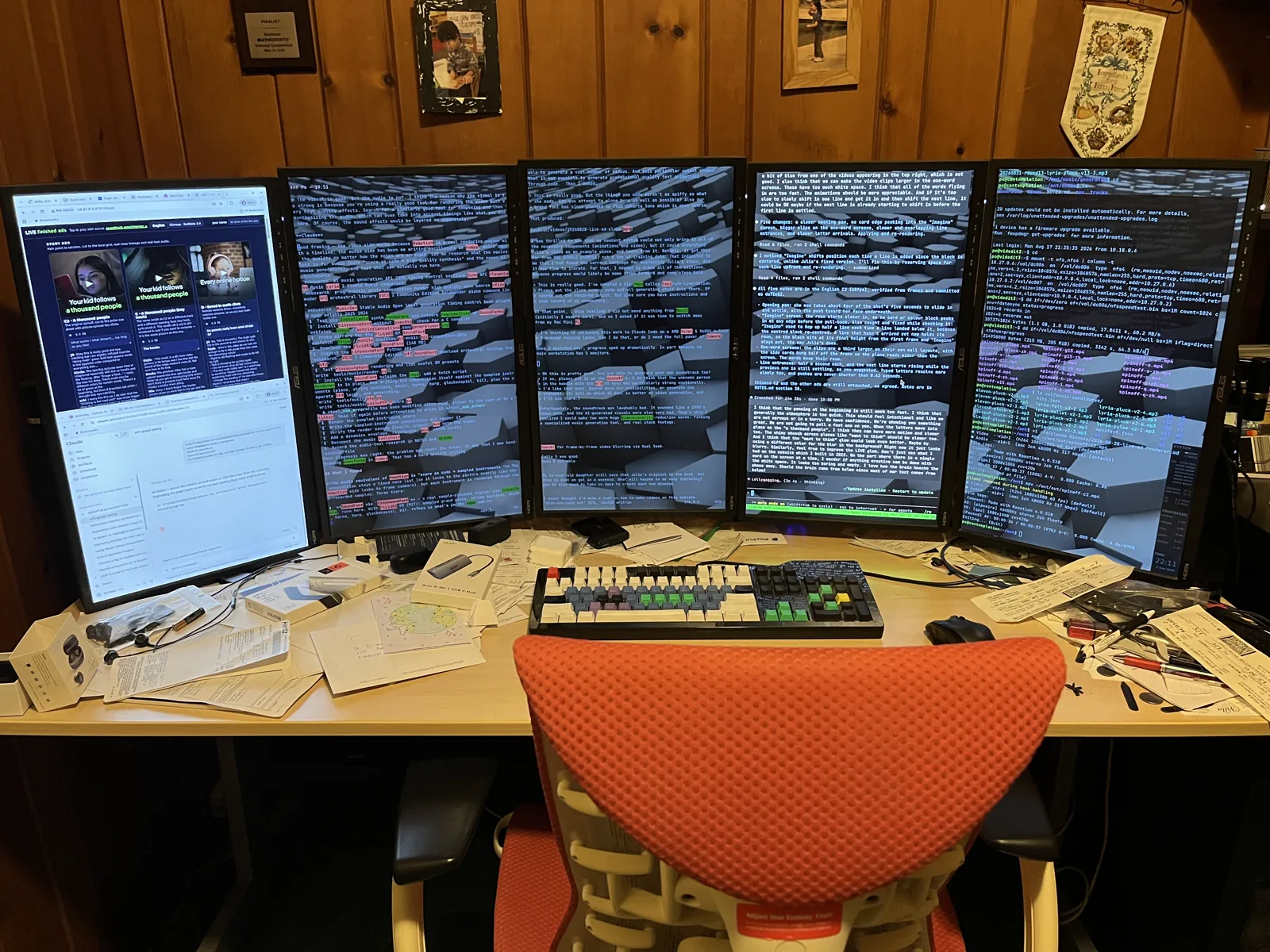
一段定制配乐
接下来是声音。过去我们就是买一段配乐,翻来覆去地用。这么短的时间就有了这样的成果,我胆子大了起来,决定做一段定制配乐。我记得和影视圈的人聊天时听说过:一部电影制作真正讲究的标志之一,就是专门谱写的配乐,能衬托、加深画面里的情绪。
可惜,那段配乐差得可笑,听起来像上世纪 90 年代的电子游戏。就算让 Claude 再加把劲,也没好多少。这时我意识到,得再降一次维:去找一个能把文字变成音乐作品的工具。
它找到了 Google Lyria 和 ElevenLabs Music。两个都不到 10 美元,我就都开通了,把 API 密钥交给 Claude Code。它随即生成了一大堆配乐让我听。可这样很不方便,因为我得在脑子里想象视频配上声音是什么效果。所以,顺理成章的下一个请求就是:
不到一分钟就做好了,还挺有格调。
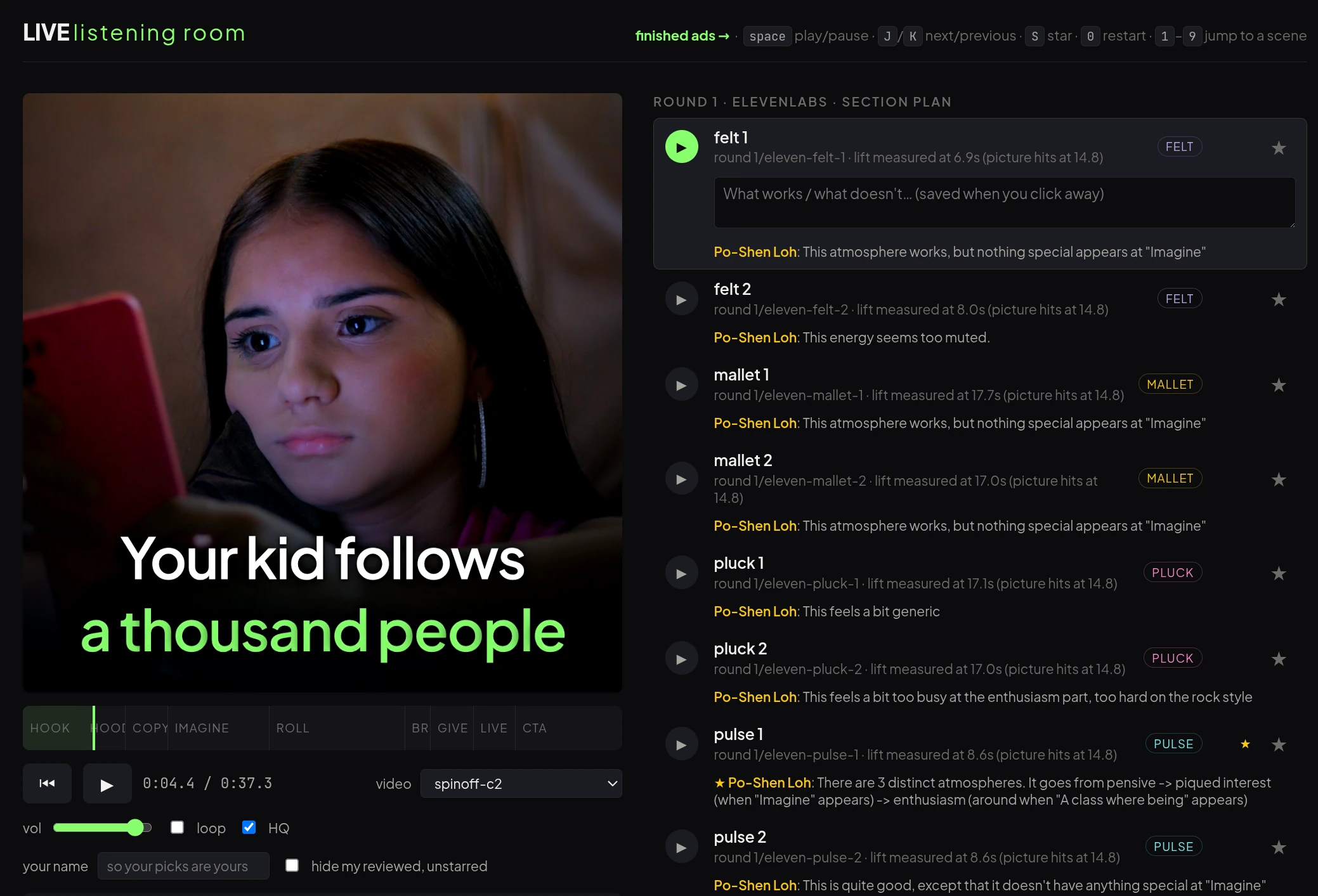
有了这个界面,我做了 7 轮反馈来"调教"音乐。音乐同样是极高维的。我想到,降维的办法可以是定下三段情绪:开头沉思,然后兴趣被勾起来,最后凯旋收尾。我想起 20 多年前听一位大学室友聊过乐理,记得有和弦进行、大调小调、转调这些说法。这些我其实都不懂,但这点常识给了我可以提的方向。最后,我有了一台能产出各种配乐的通用引擎,开头那些视频里的配乐就是这么来的。(这些配乐还不是定稿,我还在试各种写法,尤其是和弦和调性方面。)
真人镜头,有授权
然后我回到画面上。我一向不喜欢 AI 生成的画面,因为我不想展示假的东西。和 Claude 聊过之后,我了解到它能在一个叫 Storyblocks 的平台上搜素材库镜头。于是我让它把所有可能的供应商都调研一遍:
最后剩下两个主要候选:Adobe Stock 和 Storyblocks。但关键在于,Claude 搜不了 Adobe Stock,却能不登录就搜 Storyblocks。(当然,它拿不到高清视频文件,但可以翻看镜头、推荐片段。)这一点成了决定性因素。Claude Code 的搜索能力,加上它为每支广告构思的故事,正好能提供每一支作品所需的真人镜头。
到这里,每支作品的设计框架就定下来了:凡是讲我们的课,就用真实课堂的屏幕录像(不摆拍,更绝不用 AI 生成)!凡是展示外面世界的痛点,就用素材库镜头。所有这些,再用俏皮的文字动画串起来:
给 Claude 底气
对了,那条提示词的最后一句,得解释一下。我读过 Claude 的宪法(是的,全读完了),我的理解是:Claude 不应该骗人。所以我很确定,除非 Claude 自己相信我们真有过人之处,否则它不会全力以赴。为此,我早先就给它看过一份我几年前写的文档,讲我们课程的独特价值;还特意让它自己去独立调研,把这份底气建立起来:
live-unique.md14 节 · LIVE 凭什么是"独一份"
Unique aspects of LIVE by Po-Shen Loh (online math classes for middle schoolers that teach creative problem solving and critical thinking, using math contest problems)
The best instructors
- Instructors are among the most extraordinary of their generation, when considering both math skill and emotional intelligence combined
- Instructors are top finishers in competitions ranging from math to computer programming to debate
- Last year, among the instructors who graduated high school, more than half of them are now studying at MIT, Princeton, and Harvard
- They are also specially selected based upon their emotional intelligence
- They are only a few years older than the learners, and still remember what it was like to learn, but unlike other programs which have high schoolers teaching, they have received extensive specialized training in teaching and performing
- Admission to our instructor program is a highly sought-after achievement in itself, because it’s the only program which provides systematic professional performing arts training to math stars, helping them develop whole-person skills that change their life
- Why are the best instructors with us? Because in order to succeed in life (and gain admission to top colleges), it is a huge advantage to build extraordinary communication skills. If a high school math star wants to do that, they must practice at some point by talking about something and getting feedback. Our breakthrough was that we realized that the easiest topic for them to talk about is math, and then we provided professional actors and comedians to coach them simultaneously while they are teaching that math. So for them, one hour of teaching math equals one hour of feedback on their communication, and they win while learners win. (There’s no way to gain feedback without talking about something, and the easiest thing for them to talk about is math.) Nobody has ever done this before.
- We’re the only educational ecosystem for which whenever we ask an instructor to do anything, we only do it if that task is intrinsically the best use of the instructor’s time in terms of the instructor’s personal development.
- Consequently, we attract the world’s best instructors
We actually made online math class more attention-grabbing to students than in-person math class
- Nobody pays attention to a Zoom class, but the same kid can watch YouTube or a livestream all day. So we did it the other way round: instead of taking math class and putting it online, we took what everyone already watches online (a live show with hosts, a chat, production) and put math inside it. We are the first math class built that way.
- Before us, online math classes had a huge problem: they were most effective at teaching students how to sleep
- Some products tried to artificially make online math class seem more exciting with random sound effects and cartoon characters, but those are non-human, and distract from the intrinsic love of hard math as a human endeavor
- We realized that there is no fundamental reason why an online video makes kids fall asleep, because kids love watching online videos
- We realized that what makes everyone fall asleep is big boring Zoom meetings in which someone drones on and on, and the viewers passively watch
- We realized that some key differences between other online classes and actually addictive video entertainment were: (1) emotional passion of multiple co-presenters on camera, (2) intensely active chat showing the emotions and ideas of the viewers, which made the viewers feel like they were really part of the whole thing, (3) the visual appeal of the experience, as a professional looking streaming host looks totally different from a tutor sitting in their kitchen. So we built all of that in.
- Students in our class speak up more than students attending in-person classes, because we turned online into an advantage! In-person, you can’t just keep talking, because that will disrupt the sound in the room, and people can’t hear the teacher. Online, you can always hear and see the teacher, but we have a live chat feed overlaying the corner of the screen, showing everyone’s reactions at the same time.
- We also specially train our instructors to emotionally connect with students, so that they aren’t only delivering math knowledge. They’re making students interested in them from a human emotional perspective. And while they’re teaching, a professional actor keeps this training fresh.
- The instructors being close in age to the students is also attention-grabbing. Students feel emotionally closer to the instructors.
The world’s first and only math program which has 2 live-streaming instructors interacting with each other and with students just like a TV show
- This instantly makes it more entertaining and lively, much better than one instructor talking to themself
- We were able to do this because we are the first and only program to systematically train our instructors in improvisational comedy, through professional comedians, and provide them with continuous feedback while they teach every subsequent class.
- This also allows the math to be more dynamic. Instructors don’t have to worry about whether students will suggest something that is beyond their expertise, because there are 4 math experts teaching together, and even if something actually does require further research, one instructor can actively lead the class to think, while the other 3 research, and then the other instructor can take over and explain. This provides seamless redundancy. In the 1-instructor classroom, if the teacher is asked something that they don’t know about, they are stuck.
The only math program which combines extreme expertise in math with expertise in performing arts
- Founder Po-Shen Loh is a professor at Carnegie Mellon University, which also happens to be one of the very top Drama universities in the USA. It’s the same Carnegie as Carnegie Hall in New York City. Many of that university’s alumni are Broadway and Hollywood actors, who have won Academy Awards and Tony Awards. Our actors come from that extraordinary network.
- Founder Po-Shen Loh also served for a decade as the national coach of the USA International Math Olympiad team, and travels extensively to keep in touch with thousands of high school math superstars across the country.
- He was the first to bridge these two extraordinary-level worlds together.
If we can’t make your kid love hard math, nobody can
- We’re the only math class in the world which has a professional actor in every classroom, giving real-time feedback to the instructors to improve the attractiveness of their presentation
- We don’t teach routine math.
- We provide hard challenges just like a TV game show, and then use the skills from professional performing arts to encourage students to rise to those hard challenges
- We weave human emotion and excitement in, together with compassion and understanding that it’s emotionally difficult to be stuck on a hard thing
- We celebrate as students collectively make breakthroughs in understanding
- We package all of this into a professional experience
The only online math class that looks and feels like the entertainment that kids watch
- We built our own technology (combining software, hardware, and lights and equipment) to transform “Zoom School” into a professional experience
- Every other online math class actually looks the same. Ours looks totally different.
- No other online math class can make its instructors look as cool as ours, because just having the equipment isn’t enough. The instructors need to have the emotional polish to come across as professional entertainers, or else it just looks weird to have a professional setup and a person who doesn’t know how to emotio nally connect with an audience. The reason we can go all the way is because our instructors actually have those performing arts skills too.
The only online math class that dares to show actual footage of class as its advertisement
- This point actually speaks for itself.
- Every one of our math classes has a professional production team behind it, making sure that the live stream is at the quality that one would expect from entertainment
Architected and led by the world’s most famous math coach
- Po-Shen Loh’s work and discoveries have been covered in the Wall Street Journal, New York Times, National Public Radio, the Washington Post, and even international newspapers such as the Straits Times and the Australian Broadcasting Corporation
- He is the world’s most active traveling math educator, giving ~200 in-person talks per year to tens of thousands of attendees.
- This allows him to develop and maintain a deep understanding of the math needs of students and parents. That’s how he thought of this invention.
- Loh is himself a math contest star. He ranked #3 in the USA in the MATHCOUNTS competition when he was a student, and was also one of the 6 members of the USA International Math Olympiad team in 1999, where he won a Silver Medal at the world finals.
- He went on to win the USA Presidential Early Career Award for Scientists and Engineers
- He has been a math professor at Carnegie Mellon University for 14 years
- He’s the same person who was the national coach of the USA math team when it ranked #1 in the world in 2015, for the first time in 21 years
- He is also an inventor, with multiple patents
We use performing arts skills to encourage shy students to love math
- Our instructors are specially trained to notice when a usually-quiet student suggests an idea in the chat
- Many shy students are afraid to raise their hand in class because they aren’t sure whether their answer is right, and they’re worried that other people will laugh at them or think they are stupid
- In our system, students are encouraged to say brainstormed ideas which are not yet fully formed, so it is normal for lots of ideas to be still-solidifying
- When we see a student who hasn’t spoken much before, but sends a comment with a valuable bit of an idea (doesn’t even need to be fully formed), we pick them out and invite them (if they wish) to come on stage and share that idea, telling them that it’s a great idea. They are then more confident to share it, and then our instructors are specially trained like TV hosts to make them feel good about sharing that idea (“Thanks so much for sharing this!”) This encourages even shy students to actively participate, because they see that whenever anyone is called upon to present, that person is always backed up by the instructors and ends up looking good
The only math class in which if you say a wrong answer, you will still be encouraged for the right part of your wrong answer
- Instructors are specially trained in improvisational comedy, which is the art of “Yes, And”. That is the principle of a performer finding elements of truth to agree with in whatever they hear, and then adding more value in their reply. They do not just say “No.”
- Instructors are trained to instantly think about the math behind any wrong answer, and use their math skills to figure out where there might be some value. Perhaps the student started off in the right way, but made a mistake that resulted in the wrong answer. Instructors will then congratulate the student on the good part of the idea, and gently suggest that the wrong part is wrong.
- This encourages students to actively participate, because they know that as long as they’re thinking, it is safe to speak up. Instructors have their back.
The only math class in which you can really learn how to brainstorm
- Since we have a team of 4 math experts leading each class (2 on camera and 2 off-camera), students can really say any idea, and instructors can follow through with those ideas. Nothing will stump them
- Also, since our classes are video-based, instructors can dynamically write out students’ proposed ideas on screen, and discuss them dynamically. Instructors are not limited to Powerpoint slides.
- Since we have full confidence in our instructors’ ability to dynamically handle anything, the format of the class is: students are shown a problem that they haven’t seen before. Instructors invite students to brainstorm, and serve as game show hosts to help students collectively brainstorm a solution.
- Importantly, instructors DO NOT first show students an example of how to do a problem type, and then give them practice.
- The reason why our instructors can let students direct the flow of the brainstorming is because they are so good at math (and have so much backup with the 4-person math instructional team in each classroom) that they will not get stuck.
The only math class where you can learn from people who are close to your age, yet brilliant and down-to-earth, and extensively trained in the art of entertaining teaching
- Speaks for itself
The only math class that also teaches the non-math values that the top US universities look for
- Instructors are carefully screened through an intensive application process that includes an interview
- We seek instructors who are not only good at math, but also empathetic, and really love helping people
- They are role models for how a person can be simultaneously brilliant, but also are like sunshine with a real interest in helping other people
- They show students that an ideal math genius is someone who is not only great at math, but also genuinely loves helping other people
- Eventually, when you apply to college, it’s not enough just to tick a box saying that you did 200 hours of community service. What really matters is whether you fundamentally developed a love of helping other people. It’s impossible to give a kid a philosophy book to have them develop this theoretically. Role models are required. Our instructors are those role models, on the fast track to success.
The only math class where you are supposed to talk as much as you can, saying all of your ideas and your reactions
- Each class is led by a team of 2 instructors, 2 teaching assistants, and 1 actor
- We have our own special technology to put students’ comments up on screen for everyone to see, like an Instagram Live stream, but with active moderators
- Other Zoom classes could not do this, because there was no way to moderate the chat. So, during the pandemic, most people’s experience with Zoom was that the teacher told students not to chat, and then students stopped paying attention. We fixed this with our own software.
- With 4 people who have math expertise, students can ask or say anything, and every question gets answered. It’s much better than an in-person class, where if you raise your hand, you might not get called on.
- Our instructors are specially trained to manage a high-energy, highly interactive discussion. The more students who send messages at the same time, the happier they are. And they are specially trained to call on students to come on stage and voice their opinions too, prioritizing students who have not been on stage yet.
- Students actually love having their voices heard, and it makes them feel ownership in the experience.
原始文件: /live-unique.md
到最后,Claude 一支接一支地往外出广告。我甚至让它做出了中文版。
而且,既然画面、故事线和音乐都各自找到了降维用的"语言",Claude 就能自动合成整套广告;我只需要像平常聊天一样跟它说话,推着它一步步改好。比如,因为语言找对了,我用大白话说要改哪里的时间、颜色或位置,Claude 都能稳稳地改对。我那个"Buc-ee’s 加苹果加迈克尔·杰克逊"的目标,正在一点点成真。
按基线打码
我还做了几件事。最重要的一件:既然放的是真实课堂的屏幕录像,就得把学生的名字打码。这活儿之痛苦,堪比从好莱坞电影里抹掉一撇胡子。以前我的团队就是糊上一大块马赛克。现在可以做成这样:
一开始我只是让它把姓氏打码,但效果时好时坏。最后成功,靠的是让 OpenAI Codex(GPT-5.6 Sol High Effort)做一次 Goal Seek,把所有姓氏去掉,并且给了它这样一条精确打码的指令:
我用 Codex,是因为它看图似乎比 Claude 更准。GPT 5.6 Sol High 在这方面确实胜过 Opus 5。(我的 Fable 5 额度用完了。)于是我也以为,GPT 5.6 Sol High 做最终视频也会更好。结果它比 Claude 差得多。也许 Claude 就像贝多芬,耳朵聋了照样能作曲。
上面这些步骤,加起来大约只用了一个周末。说"大约",是因为到周末结束时,我手上的视频已经能看出这里展示的这些版本的故事线和视觉效果了,只是还有些毛边。之后又断断续续花了几天,给出细致的反馈,把它们打磨到位。话说回来,那个周末我其实也没怎么干活:大部分时间都在从匹兹堡坐灰狗巴士去印第安纳波利斯再回来的路上,因为我去那儿做了一场关于 AI 之后世界的演讲。
一些想法
我从没想过自己会写一篇教人做视频的文章。我大学读的是纯数学,后来的学位也都是纯数学。可看起来,在如今的 AI 时代,纯数学对"复杂性以及如何化简它"的直觉,配上足够宽的知识面和阅历,真的很管用。
我有专业设计师那么好吗?绝对没有。我也一直佩服那些探索创意和能力极限的人。但我(在预算极其有限的情况下)能做的事,可能性一下子大了很多。比如,我现在正考虑开一档视频播客,因为我可以搭一条自动剪辑、自动分享精彩片段的流水线。
那么,人在哪里?这不就是在制造更多的 AI 垃圾吗?其实不是。在这个过程里,目标从头到尾都是做出有标志性的东西,而不是平庸的东西。能把大事拆成小块的人,依然极其宝贵,因为正是这种能力,让你能把自己的愿景有效地传达出去。平庸,来自没有愿景。做有标志性的存在。搞清楚你到底是谁。
从某种意义上说,这整套广告的内核,来自我们多年前的一个决定:把数学明星、职业演员、网络直播和社会公益这几个世界揉在一起。正是这个决定,带着我开车跑遍全美,做我的巡回演讲和倾听之旅,帮大家赶在 AI 前面。也正是这些旅程,让我发现了 Buc-ee’s 的妙处,我用 iPhone 给它拍了照,就夹在一首首迈克尔·杰克逊的歌之间。